


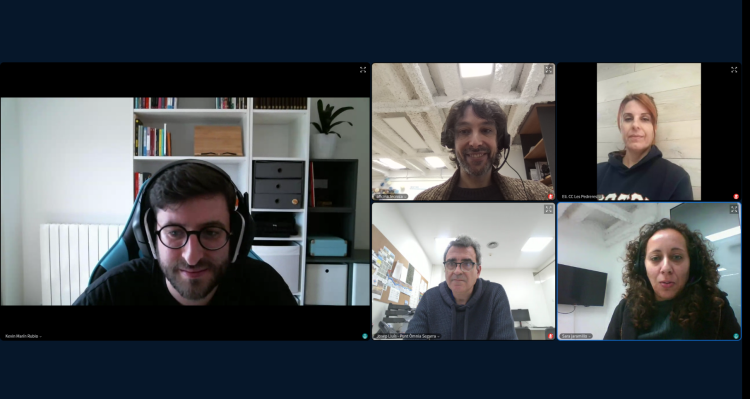
Last Tuesday, February 24, the Punt TIC Network experienced the second virtual meeting of the year 2026. The new online session focused on video games as a transformative educational tool and had around fifteen participants, including Kevin Marín Rubio, predoctoral researcher at the Faculty of Education of the University of Barcelona. Trained as a teacher and professor, with studies in philosophy, his work in formal education, informal education and cultural dynamization has always been closely linked to critical pedagogy and the promotion of reflection on structures. First of all, the Punt TIC spoke about their experiences with video games, such as, for example, through the 'Digital Fiction' initiative that is promoted by Lucas Ramada Prieto and carried out by some municipal libraries in the territory. Marín then presented his research on the 'Play Utopia' video game club that takes place in the Casal de Barri Besòs in Barcelona and that began its journey in 2023 with the support of the Taula Jove and the neighborhood's youth development services. The 'Play Utopia' video game club has three seasons with stable groups, four educators and around thirty young participants aged 12 to 20. Every week, boys and girls play, debate and reflect on topics of interest. The main objective of the video game club is to create imaginaries of futures that are desirable, opening spaces for criticism, appropriating video games as a cultural medium and promoting transformative action. Marín raised the importance of entering into the conversation with young people, because otherwise it is the market that enters this conversation with addictive proposals and violent options.
Marín pointed out that it is necessary to offer critical alternatives that focus on utopian futures and not dystopian futures. Likewise, Marín recommended starting with video games that are close to the playful background of boys and girls and, little by little, introducing other possibilities. In this sense, Marín proposed some examples of interesting video games, such as, for example, 'Papers, Please' to talk about migration and racism, 'Every day the same dream' to deal with job expectations, 'Unpacking' to address the gender issue, 'Everything' to see life from other perspectives, or 'Townscaper' to address social classes and the future of communities. Marín highlighted the role of the educator in leading the session with the youth and highlighted that video games are triggers of conflicts and tools to introduce the topics. The virtual meeting ended with an open round of questions and reflections, where the facilitators were able to ask about the possibilities of video games within the Linux system, some recommendations for International Women's Day or the richness of creating clubs that mix adults and minors.