


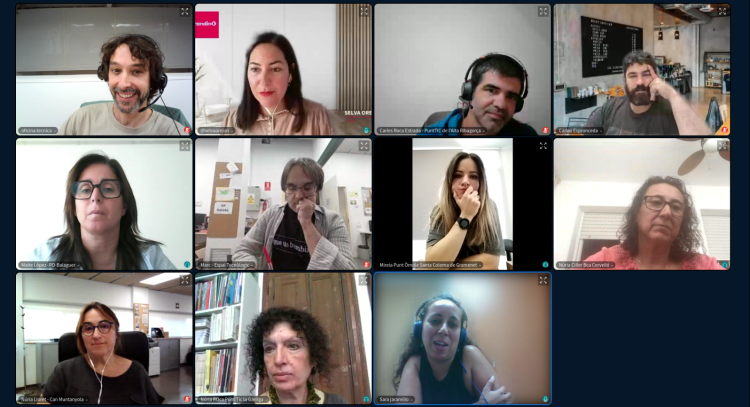
Last Tuesday, October 14, the Punt TIC Network experienced the sixth virtual meeting of the year 2025. Within the framework of the European Cybersecurity Month, the new virtual meeting of the Punt TIC Network focused on a safer, responsible and critical digital world and had more than twenty participants, including Selva Orejón , expert consultant in cybersecurity, reputation and digital identity and founder of the cyberintelligence company Onbranding, and Esther Subias, project manager for the Digital Gap Response Plan.
First, Esther Subias briefly presented the 'Més Digitals' program , an initiative of the Generalitat de Catalunya to train people at risk of digital exclusion. The 'Més Digitals' program began last January with three training itineraries: 'Discovering the digital world', 'Moving through the digital world' and 'Deepening into the digital world', which were especially aimed at an audience over 65 years old. This October, after much learning, the 'Més Digitals' program expanded its training offer with a fourth training itinerary: 'Protecting ourselves in the digital world', to learn about useful and practical tools for security in the digital world such as online shopping or protected devices. Subias announced that the program's training offer would soon be expanded again with three new proposals for a more general audience: cybersecurity and privacy, artificial intelligence and parental support in the digital environment.
Next, Selva Orejón began his presentation by explaining the three services offered by the cyberintelligence company Onbranding: the management of cybersecurity attacks on public figures and multinational companies, the recovery of normality after having suffered a smear campaign or a reputational crisis, and training for security forces, administrations, universities and citizens. Orejón then differentiated between two types of artificial intelligence: weak artificial intelligence (virtual assistants) and strong artificial intelligence (tools that can reason and learn like a human). At this point, Orejón specified that artificial intelligence could reason, but could never reflect, since this was a quality unique to the human race. Orejón defended that artificial intelligence could be applied to different sectors of activity, such as cybersecurity, medicine or the business fabric.
However, Selva Orejón stated that this was a revolution that was here to stay and posed risks and challenges: ethical challenges, cognitive biases and psychological biases, privacy and security, data protection and impact on employment and studies. Therefore, Orejón highlighted the need to establish a code of ethics and use of artificial intelligence in all organizations. Orejón also shared some protection measures: two-factor authentication, care with personal information, caution with the information we share, understanding the security settings of applications and continuous training. Orejón then ended by talking about the risks linked to third parties such as the creation of images (deepfaces) or the creation of voices (deepvoices) and recommended cross-verification as a security measure to detect fraud (deepfake), that is, the comparison of information through various information channels.
Finally, an open round of questions concluded the new virtual meeting. Some of the questions were how the Punt TIC can advise citizens on cybersecurity issues. Orejón recommended making a summary of the incidents and establishing action protocols, as well as making inquiries to official channels such as the Consumer Union of Catalonia, the Cybersecurity Agency of Catalonia or the National Institute of Cybersecurity.