


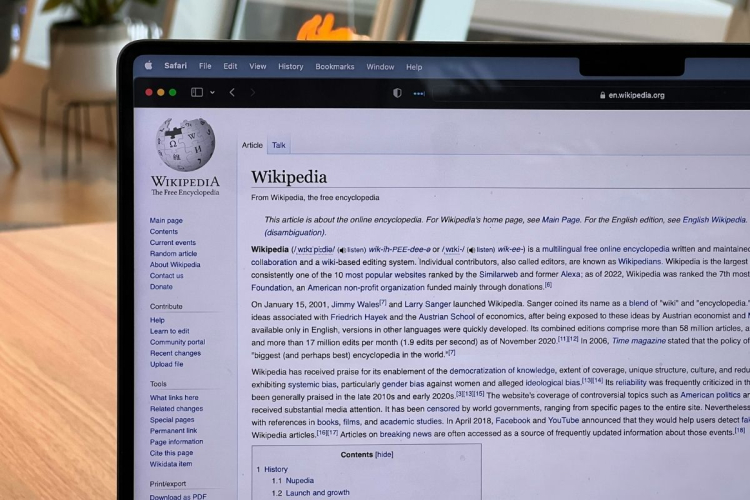
Last Thursday, January 15, Wikipedia blew out 25 candles. A quarter of a century earlier, on January 15, 2001, the world's largest free encyclopedia was launched by Jimmy Wales and Larry Sanger. The collaborative project collects knowledge on the Internet and contains entries on various topics. As a curiosity, the first entry published was about the abacus, an instrument for manually calculating arithmetic operations. Little by little, Wikipedia has become a global reference source, which allows learning, which allows teaching and which allows gathering the knowledge of all humanity.
Maintained by the Wikimedia Foundation, the initiative has 66 million articles in 342 languages. Its entries written collaboratively by users from all over the world are examples of how knowledge can be built, shared and disseminated in an accessible, transversal and altruistic way. Today, the top positions in the language ranking are for the English version, with 7.1 million articles, the Cebuano version, with 6.1 million articles, and the German version, with 3 million articles. As for the Catalan version, it has nearly 800,000 articles, which represent 1.2% of the total articles and place it in twentieth place.