


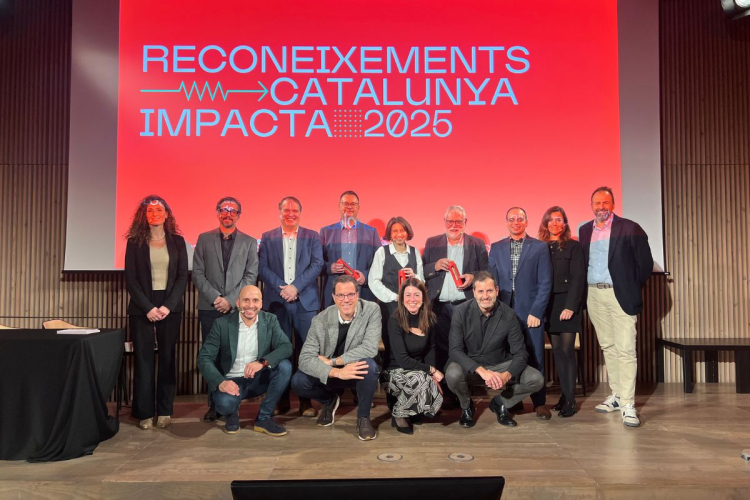
The Cercle Tecnològic de Catalunya held the awards ceremony for the fourth edition of Catalunya Impacta on Thursday, November 27, a program to recognize the best initiatives that value the transformative nature of new information and communication technologies on the economic and social fabric of Catalonia. Specifically, the awarded projects stood out for their innovative capacity and agreed to bet on the use of artificial intelligence tools for monitoring.
Specifically, within the Catalunya Impacta 2025, in the primary sector category, the awarded project was 'ETRIA' from Empordàlia. The initiative consists of a system based on cameras, strobe lighting and artificial intelligence models that allows the olives entering the mill to be analyzed in real time to determine the quality precisely and objectively and facilitate decision-making on the production line. In the industrial sector category, the awarded project was 'Aracne Textile Solutions'. The initiative consists of predictive systems that incorporate photonics, artificial intelligence and the Internet of Things in the quality control of the fabric manufacturing process and analyze every millimeter of the fabric to detect anomalies imperceptible to the human eye and monitor in real time the condition of the needles of the circular machines to anticipate their wear and facilitate maintenance. In the services sector category, the awarded project was 'EOSS' from the Bellvitge University Hospital. The initiative consists of a transformation of the care model for heart failure to make it more sustainable and person-centered through data monitoring, artificial intelligence and machine learning that allows daily, constant and remote support that makes it possible to anticipate decompensations and generate alerts to facilitate early intervention and improve the quality of life of patients, as well as move towards more humane medicine.